
Elias Dib
It all began with a crash. While leading an international mountain bike stage race in Kenya, Maxime Chaya suffered an accident that forced him into surgery, rehab, and months of training. The following year, he returned to Africa with unfinished business. He won the race and was invited to climb Kilimanjaro. Watching the sunrise from the roof of Africa, he realized this was only the beginning. That moment ignited a journey that would take him to the highest peaks, the coldest poles, the roughest oceans, and eventually, the most unforgiving desert on earth.
7 Summits. 3 Poles. 1 Ocean.
Over three years, Maxime completed the Seven Summits. Each ascent he attempted carried its own trials. He pursued Gasherbrum II (8,035 m) as part of his preparation for Everest, but turned back before the summit due to heavy snow and unsafe conditions; yet nothing tested him more than Everest in 2006. On his descent, exhausted and oxygen‑depleted, he encountered a dying climber, David Sharp, in the Death Zone, beside the body of another climber known as Green Boots. Despite the danger to his own life, he and his Sherpa Dorjee stayed with Sharp, administering oxygen and desperately trying to revive him. Later, Chaya would say, “He was much closer to death than he was to life,” a moment that stayed with him long after the mountain.
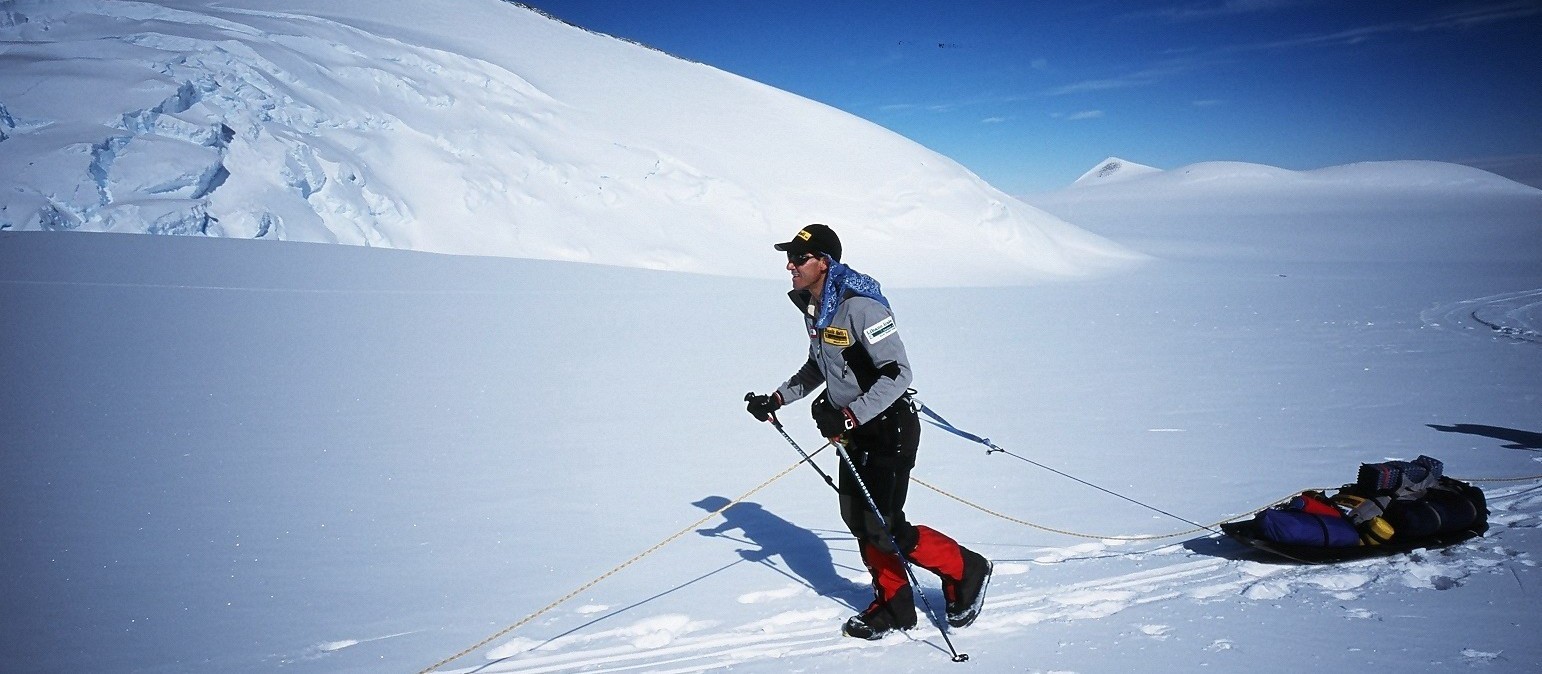
That experience deepened his curiosity: a drive to explore, to learn, to test the boundaries of what the human body and spirit can endure. His growth path was never linear. After the Seven Summits, he shifted terrains entirely, skiing unassisted and unsupported to both poles, then rowing across the Indian Ocean in record time as part of the first three‑man crew ever to cross any ocean. Each new challenge demanded a different technical skillset, yet he carried forward the same discipline, endurance, and meticulous preparation that had defined his mountaineering years. He embraced uncertainty and risk with the same conviction that had taken him to the roof of the world, attempting world‑firsts and continuing to plan even more ambitious routes.
1 Desert, Twice.
Maxime went on and attempted something no one had ever done before: crossing the Rub’ al Khali, the Empty Quarter, by bicycle. Along the way, he discovered new limits within himself, and as he often says, “Not everyone needs to climb Everest. But everyone has their Everest to climb!”
In 2016, Chaya and his teammate Steve Holyoak became the first to cross the Empty Quarter by bicycle in an expedition named BRAK (Biking Rub’ Al Khali). The BRAK route began in the UAE at Abu Dhabi and took them across the border into Oman and then south west to the finish at Salalah. Cycling 1,453 km in 21 days, unsupported, they proved that what seemed impossible could be achieved.
Six years later, they returned for ATG (Against The Grain), a 2,640 km crossing against prevailing winds; possibly the longest unassisted bicycle crossing of the largest sand desert in the world. The journey began on November 18, 2022, in Jeddah on the shores of the Red Sea and Maxime and Steve finally wheeled to a halt, completing the journey on December 21, in Muscat in the Gulf of Oman. As Maxime reflected after ATG: “All good things come to an end. Another successful escapade, another tick in my to-do list, and several more valuable lessons learned along the way.”
Both expeditions demanded meticulous preparation. BRAK took nearly three years of planning. For ATG, nothing was left to chance: “Preparation is key… we carefully prepared and rehearsed everything: the route, navigation, hydration, nutrition, communication, mitigation and emergency procedures and much more!” The respect for nature was evident in his insistence on leaving no trace, returning to collect unused supplies, and responsibly disposing trash daily. “Take nothing but photographs and leave nothing but tire marks,” he said of BRAK.
Maxime and Steve relied on trust, communication, and mutual respect, coordinating routines and sharing risks in an environment where even small mistakes could have serious consequences. The harshness of the desert demanded a shared discipline: pacing together, solving problems together, and respecting each other’s limits. In a place where nature set the rules, their ability to operate as a unified team became as vital as their equipment, their planning, and their physical endurance.
Wisdom from the Wild
Behind every summit, pole, ocean, and desert crossing lies a set of behaviors that leaders can apply in their own challenges; whether in boardrooms, teams, or personal pursuits.
Leading the Business | Leading Others | Leading Self |
Planning & Preparation Great leaders don’t rely on courage alone; they build success long before the journey begins | Empathy Your humanity in tough moments defines you far more than your achievements | Pioneering Spirit Breakthroughs happen when you dare to go where no one has gone before |
Environmental Stewardship Leaders who respect the environment they operate in make wiser, more sustainable decisions | Partnership The right partner multiplies your strength; especially when the terrain gets unforgiving | Curiosity Growth begins the moment you choose to stretch and explore what lies beyond your current horizon |
Adaptability Your ability to easily shift disciplines, environments, and mindsets is often your greatest advantage |
The Journey Beyond the Journey
Maxime Chaya’s story is one of trailblazing, inquisitiveness, flexibility, grit, compassion, collaboration, preparedness and respect for nature. He reminds us that the summit is only half the journey, that all problems have solutions, and that every person has their own Everest to climb.
Photo Credit: Maxime Chaya