

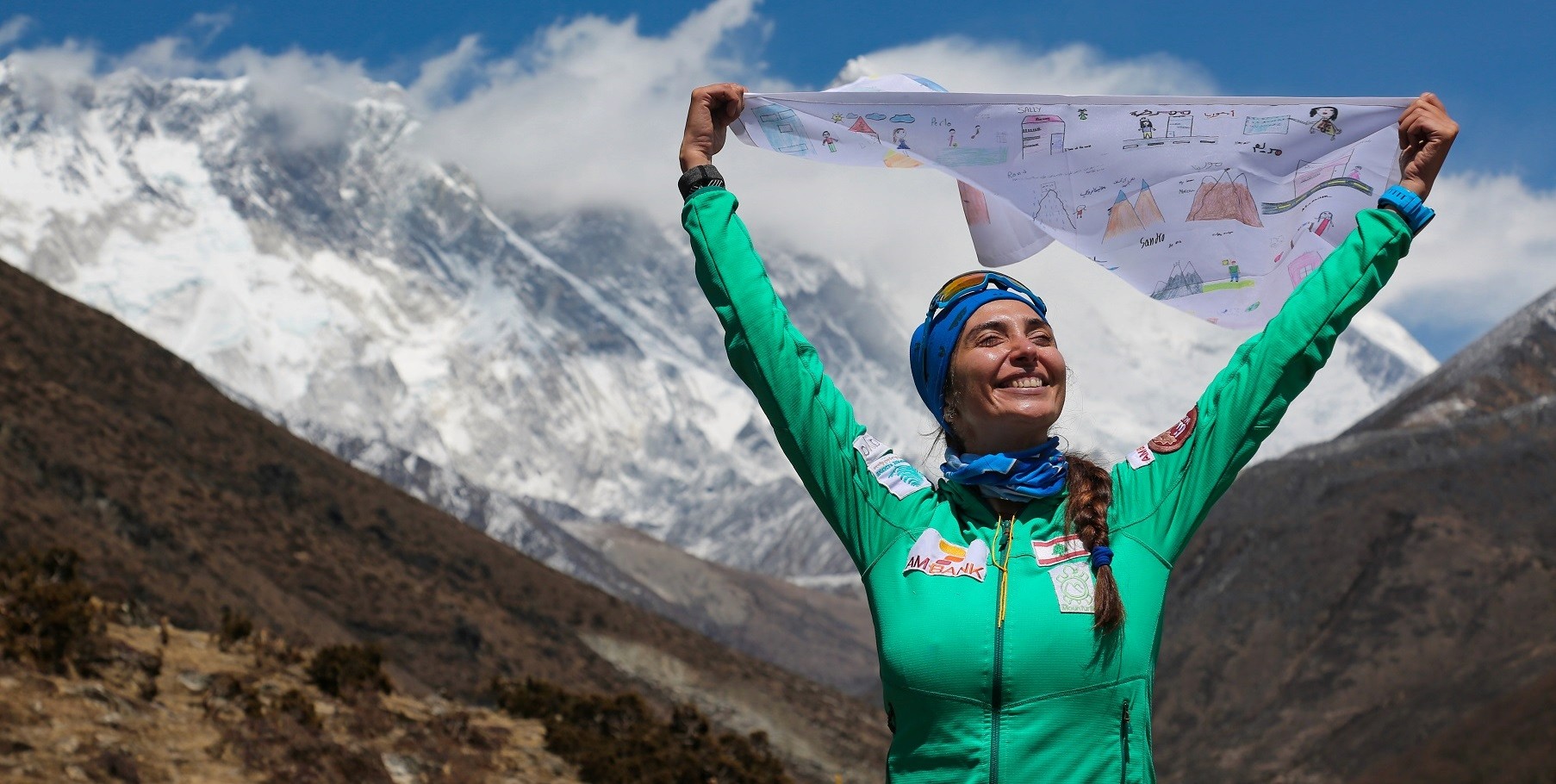
Elias Dib
“Once upon a time, a little girl had no permission to dream because of her gender and social class. Growing up she met the Lebanese mountains and since then the mountains mentored her to be a strong woman mountaineer.”
Joyce Azzam was born in Beirut during the Lebanese Civil War. Her early years were shaped by instability and physical limits. She remembers “moving from bunker to bunker, continuously living underground,” and she grew up with a chronic lung condition and hypermobility syndrome that made sport and movement difficult. Yet those constraints became the raw material of a different story: one of incremental practice, stubborn curiosity, and a refusal to let other people’s expectations define what she might become.
Joyce built a life that moves between two worlds: rigorous academic study and the unforgiving slopes of the world’s highest peaks. She is the first Lebanese woman and one of the first Arab women to complete the Seven Summits after reaching the top of Everest in May 2019.
The Long Arc Toward the Summits
Joyce’s path to the Seven Summits was not a single dramatic leap; it was a decade of accumulation. She left an architectural career, pursued multiple advanced degrees (including a Ph.D.), and layered formal study with relentless physical training. She describes training routines that often exceeded 20 hours per week, and she deliberately used local terrain as a laboratory. She trained with weighted packs, sleds, stair climbs, and ice bath conditioning to expand tolerance for cold and fatigue. On Denali she hauled more than 60 kg; in Lebanon she practiced carrying 29 kg packs up 800-meter climbs to build endurance. She learned ropework, crevasse rescue, oxygen system operation, and how to move on steep ice and mixed terrain; skills practiced repeatedly on smaller peaks before being tested on the big ones.
Joyce spent years pitching sponsors, working side jobs, and sequencing expeditions so that each climb advanced both experience and credibility. She openly recounts the year she nearly abandoned the Seven Summits plan because of funding shortfalls and how persistence kept the dream alive.
Her climbs followed a deliberate sequence. She began with regional peaks, then moved to continental objectives: Elbrus in Europe, Denali in North America, Kilimanjaro in Africa, Aconcagua in South America, Puncak Jaya and Kosciuszko in Oceania, Vinson Massif in Antarctica, and finally Everest. Each expedition taught a technical skill, a logistical lesson, or a psychological habit; lessons she recorded and shared with followers and students. She calls the process “step-by-step,” a mantra she repeated on the hardest nights: “one more step Joyce… c’mon it is only one step.”
Throughout, she turned failure into fuel. After a painful retreat from Aconcagua in 2012, an experience she calls a formative failure, she trained for five years and returned to stand on that summit in 2017. Her definition of failure is practical: “Failure is an event, not an identity.”
The Everest Summit Push: A Night That Tested Everything
The final push on Everest is a study in micro-decisions. Joyce describes leaving Camp 4 at 9:45 p.m. for the summit ridge, moving in the dark to reach the summit in the early morning and return before afternoon storms. She remembers the night as “one hell of a night” that mixed pain and joy, fear and clarity. At 8,000 meters the body is fragile and the mind is the instrument that must be kept steady; she counted breaths, repeated her mantra, and trusted the rhythm of the team leader’s steps. “One step at a time,” she wrote - an instruction that turned a terrifying night into a sequence of manageable actions.
Breathwork, visualization, and small daily rituals were non-negotiable. She used controlled breathing to manage panic on the Lhotse face and practiced short meditations even in the Death Zone to keep fear from becoming paralysis. “It is a mind game up there, if you lose it, you're done!” she wrote.
She also recorded the practical anxieties: oxygen systems that must not fail, the risk of frostbite when filming a few seconds on the summit ridge, and the constant calculation of whether to push or to turn back. Those moments required both humility and courage: humility to accept the limits of the body and courage to keep moving when the summit was still hours away.
“The top of the world. But for me, it was more than a summit. It was the celebration of a 7-year journey.”
The Human Scaffolding Behind the Achievement
Joyce repeatedly credits the people who made the climbs possible: sponsors, guides, Sherpas, teammates, family, and her brother Georges. She learned to carry a Sherpa’s load to understand how much they do; she names leaders whose judgment she trusted on Everest; and she thanks her close supporters for years of coaching and emotional steadiness. “I could not achieve anything without my support system,” she says, and she frames success as a collective achievement rather than a solitary triumph.
Lessons for Leaders | ||
Behavior | What did Joyce do? | What can you do? |
Ambition | Held a vision far bigger than her circumstances and refused to let limitations define what was possible | Challenge limiting beliefs and create conditions where people feel safe to imagine goals beyond their current reality |
Perseverance | Turned her vision into a structured, step-by-step, long-term plan with milestones, training cycles, and disciplined follow-through | Create a consistent cadence of action: small, repeatable steps that keep momentum alive even when motivation dips |
Self-development | Expanded her capability through formal learning, technical training, and relentless practice | Promote continuous learning and cross-training so people can grow into new roles and handle higher-stakes challenges |
Team Reliance | Depended on guides, experts, and teammates to navigate risk and reach the summit safely | Invest in team selection, shared protocols, and the psychological safety so people can rely on each other under pressure |
Self-management | Understood her fears, limits, and emotional triggers and used that awareness to stay rational and composed in extreme conditions | Understand your emotional patterns and blind spots and use that awareness to regulate behavior and remain steady in high-pressure moments |
Positive Mindset | Reframed adversity by shifting from a “victim” identity to a “learner” identity | Model the shift from self‑criticism to self‑compassion by reframing challenges as opportunities to grow |
Resilience | Recovered from setbacks, injuries, and failures by treating them as calibration rather than defeat | Make recovery and decompression part of your operating rhythm so teams return stronger after difficult cycles |
Trust | Balanced inner conviction with trust in others’ judgment, especially when conditions were uncertain | Choose trustworthy partners and demonstrate trustworthiness yourself, especially when stakes are high |
Wellbeing | Prioritized mental preparation, pacing, and recovery to sustain clarity and endurance over multi-year challenges | Normalize wellbeing practices and provide resources that support sustained psychological and physical fitness |
After the Summit: Purpose Beyond the Peak
Joyce reached Everest’s summit on 23 May 2019 and completed the Seven Summits, a milestone that transformed personal triumph into public purpose. The achievement did not end Joyce’s work; it redirected it. She founded MounTurtle, created an eight-module mountaineering training program, became UN Women Goodwill Ambassador, and took on public roles that translate personal achievement into social impact. She uses her platform to speak about mental health, gender equality, and environmental stewardship; issues she links to the discipline and perspective gained on the mountains.
An Invitation to Climb
Joyce Azzam’s life is a practical curriculum in how to convert constraint into capability. Her story is not a myth of effortless heroism; it is a record of small, disciplined choices (training sessions at dawn, awkward conversations with sponsors, nights of doubt in a tent at 8,000 meters) that together produced extraordinary outcomes. She asks only that others show up: “You don’t have to be ready. You just need to be willing.”
For leaders facing their own peaks, the invitation is simple: set your direction, trust your footing, practice the steps, and keep breathing. One step at a time.
Photo Credit: Joyce Azzam